Compare niche creator activation with legacy creator tools
Lobby is niche and hyper-local creator activation. It decomposes a brief into niche topics, finds creators who already publish that content, validates fit and location, and charges only after you approve a validated creator. These pages show how that differs from databases, CRMs, audience audits, marketplaces, and custom scrapers.
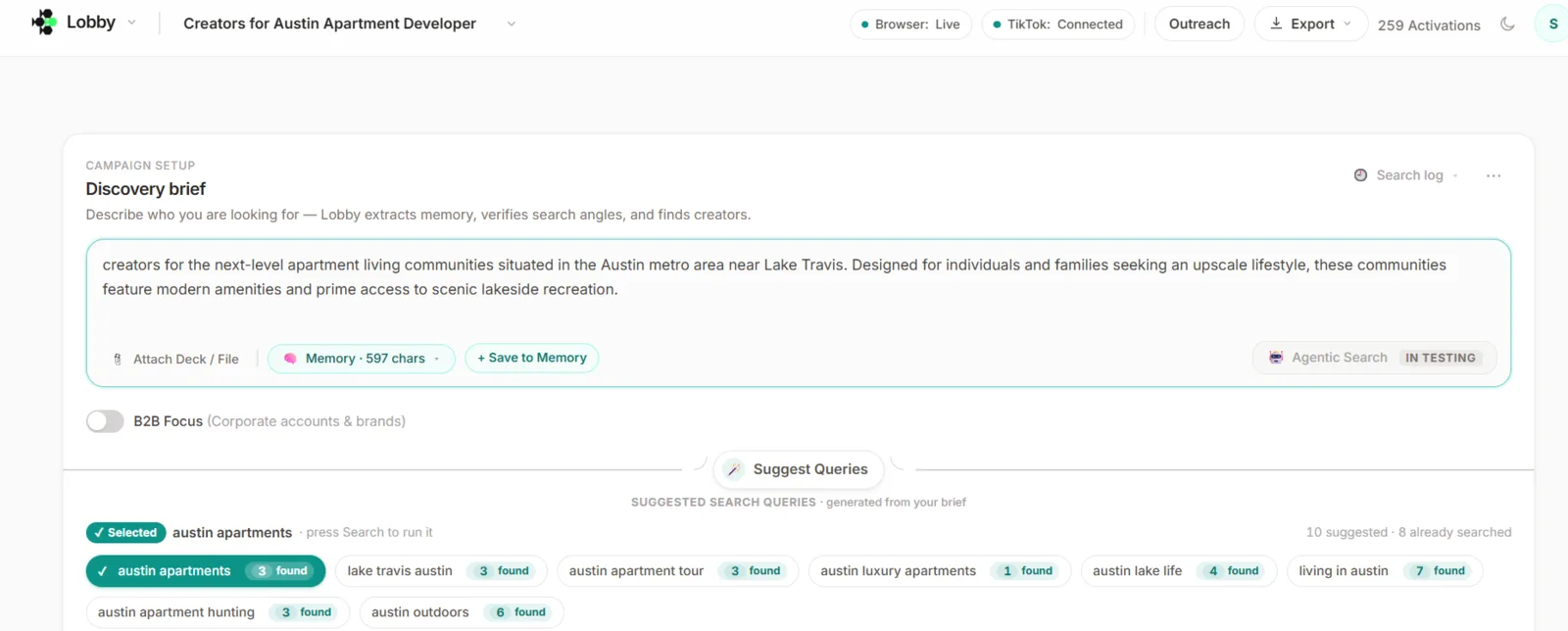
Demo workspace. A brief becomes niche search topics before any creator is contacted.
Most creator tools start with a profile, a filter, a score, a script, or a raw dataset. Lobby starts with the task. That changes what gets searched, what gets validated, and what you pay for.
Eight things every comparison page checks
The same eight steps appear in every page. They are the offer, not a page-specific angle.
Brief in
Lobby reads the business context from the brief or website.
Niche topics
The task becomes three to six concrete niche topics.
Content search
Lobby searches actual creator content, not only profile metadata.
Latest-content check
Creators whose latest content does not match are disqualified.
Location validation
Three independent sources must agree for a hyper-local task.
Fit profile
Content, reputation, competitor work, location, and contact route.
Client approval
Nothing is activated until the client approves the validated creator.
Pay per activation
Lobby charges only after approval. Browsing and vetting do not burn credits.
How Lobby decides who fits the task
These are demo fit checks from an Austin apartment campaign. The same brief can produce a mid fit, a low fit, and a high fit. The difference is evidence, not a profile tag.
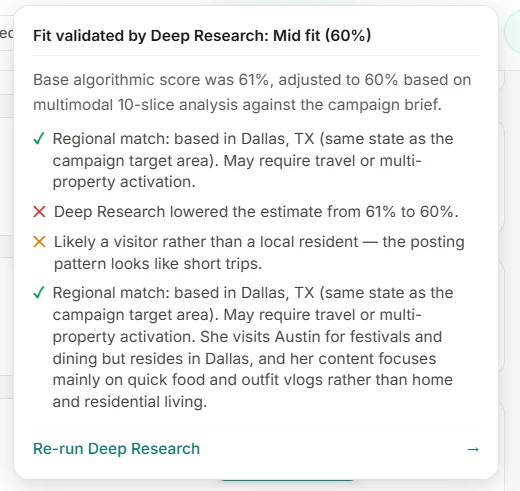
Region matches, residency does not
The creator is in Dallas, not Austin. The posting pattern looks like short trips, so the score is lowered instead of treated as a local match.
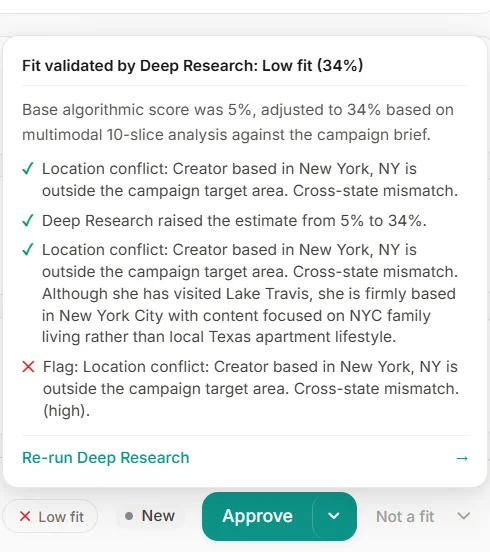
A past visit is not a local footprint
The creator has visited Lake Travis, but the account is based in New York and the recent content is New York family life. Location conflict stays flagged.
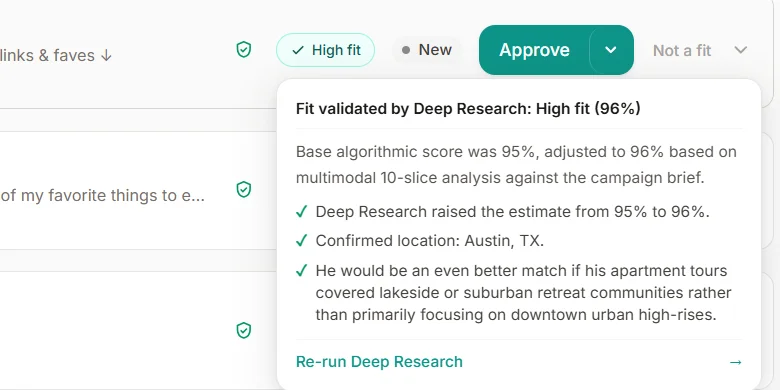
Current content and location agree
Austin is confirmed, the content is in the right category, and the remaining gap is a thematic note for the brief. This is the creator a client can approve.
Screenshots from a Lobby demo workspace. Names, handles, and contact details are not shown.
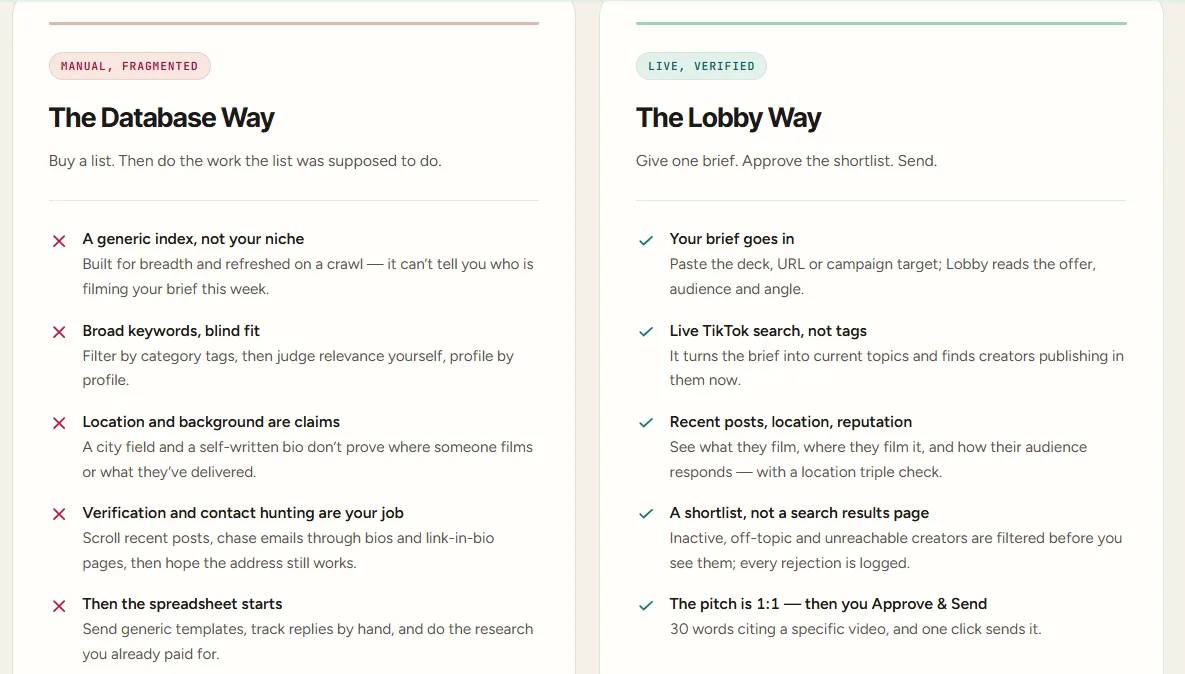
Database way vs Lobby way
The hub is not a list of features. It is a comparison of what happens to the brief. A database returns profiles. Lobby returns a shortlist with reasons.
- check_circleThe brief becomes niche topics before search.
- check_circleThe search reads current creator content, not only profile tags.
- check_circleLatest-content mismatches are disqualified.
- check_circleLocation is checked from three independent sources.
- check_circleThe client approves the validated creator before activation.
Eight comparisons, one operating difference
Each page keeps the competitor's real strengths and shows where the task-to-validated-creator loop changes the answer.
Lobby vs Click Analytic
Click Analytic provides a 425M+ profile database, API, lookalikes, AAS, and warehouse delivery. Lobby starts from the brief and validates current content, location, and approval.
Read comparisonarrow_forwardProfile discoveryLobby vs Modash
Modash is strong for broad profile search and audience data. Lobby starts from the brief, decomposes it into niche topics, and validates the latest content and location.
Read comparisonarrow_forwardEnterprise creator operationsLobby vs GRIN
GRIN handles long-term relationships, seeding, and fulfillment. Lobby handles the task-level discovery and validation step before a roster exists.
Read comparisonarrow_forwardAudience auditsLobby vs HypeAuditor
HypeAuditor scores historical audience quality. Lobby validates current content fit and location for a specific brief.
Read comparisonarrow_forwardManual sourcingLobby vs SARAL
SARAL helps small teams collect creators by hand. Lobby decomposes the brief and runs content-level search, latest-content checks, and location validation.
Read comparisonarrow_forwardTransactional UGCLobby vs UGC Marketplaces
Marketplaces sell scripted video deliverables. Lobby activates niche creators who already publish in the category.
Read comparisonarrow_forwardEnterprise IRMLobby vs Upfluence
Upfluence manages affiliate and ambassador programs. Lobby finds and validates the niche creator for a specific task, then prepares one-to-one outreach.
Read comparisonarrow_forwardCustom data pipelinesLobby vs In-House Scrapers
Custom scrapers return raw data. Lobby turns the brief into niche topics, disqualifies stale fits, validates location, and prepares outreach.
Read comparisonarrow_forwardPay for activation, not for browsing
Lobby uses pay per activation. You can browse, vet, and evaluate creators without burning credits. The charge happens only after you approve a validated creator.
- check_circlePay per activation after approval.
- check_circleNo credit burn on browsing and vetting.
- check_circleNo annual lock-in and no onboarding fee.
- check_circlePricing is per validated creator, not per database seat.
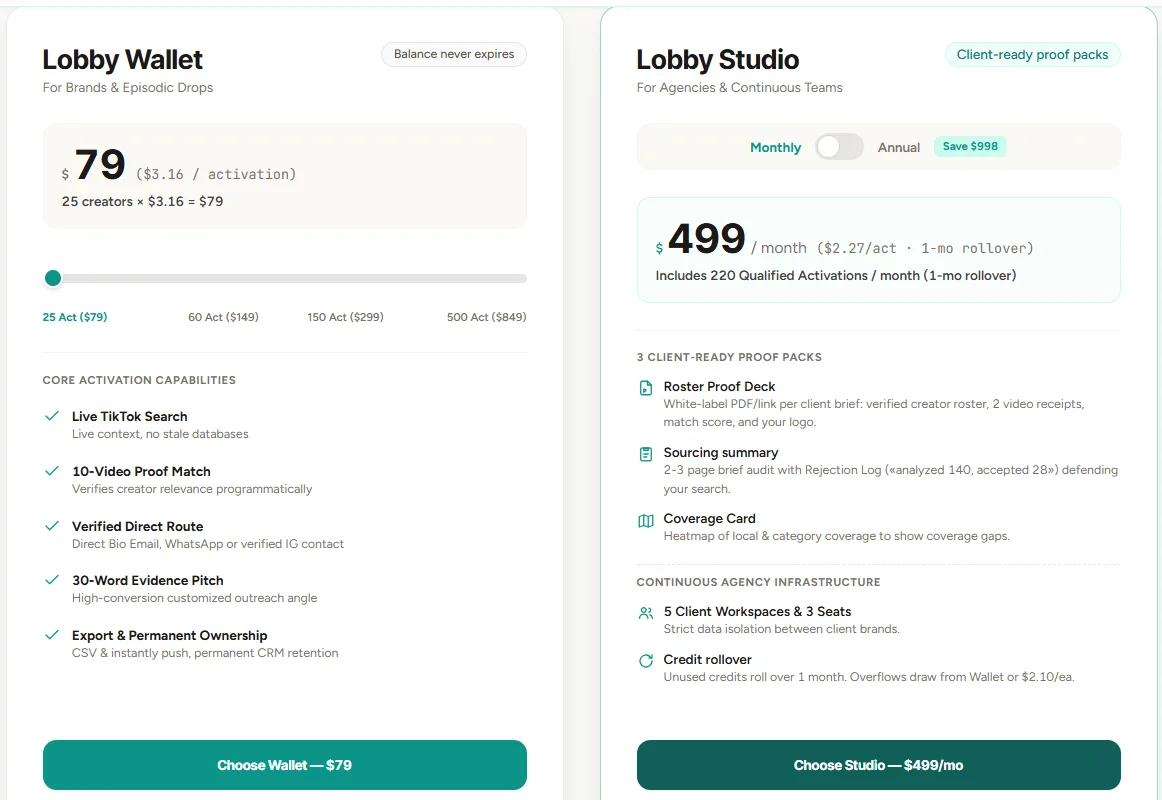
Current public plans. An activation is one validated creator with a contact route and a ready-to-send pitch.
What Lobby is and is not
The offer is intentionally narrow. These boundaries keep the comparisons honest.
- infoLobby does not guarantee revenue, ROI, virality, or creator performance.
- infoLobby does not replace a PMS, booking engine, affiliate suite, or warehouse logistics platform.
- infoLobby does not remove the need for human judgment in creator selection.
- infoLobby is not an enterprise governance or compliance suite.
- infoLobby does not claim that every contact in every market is verified.
- infoLobby is not a CRM, marketplace, agency, or generic influencer database.
Frequently asked questions
Direct answers on niche activation, the offer, and how it differs from the tools in these comparisons.
What is niche and hyper-local creator activation?expand_more
Lobby reads a business brief or website, decomposes the task into three to six niche topics, searches actual creator content, disqualifies creators whose latest content does not match, validates location from three independent sources, builds a fit profile, waits for the client to approve the validated creator, and prepares one-to-one TikTok and email outreach. The client pays only after approval.
How is Lobby different from a creator database?expand_more
A creator database starts with profiles and filters. Lobby starts with the task. It defines niche topics and content-fit criteria, checks the latest content, validates location, and builds a fit profile before it asks for approval. Lobby is not a database and does not sell database size.
Does Lobby replace my CRM or affiliate platform?expand_more
No. Lobby is not a CRM, marketplace, agency, or affiliate suite. It can sit alongside those tools when the job is niche or hyper-local activation. Keep your CRM for long-term relationships, payouts, and fulfillment.
Can I use Lobby alongside the tools in these comparisons?expand_more
Yes. Lobby is an activation layer for a specific brief. Keep a database for broad research, a CRM for long-term relationships, an audit tool for fraud checks, or a marketplace for generic scripted video. Use Lobby when the job is niche or hyper-local activation.
How does Lobby charge?expand_more
Pay per activation. Browsing, vetting, and evaluating creators do not burn credits. Lobby charges only after the client approves a validated creator. There is no annual lock-in and no onboarding fee.
Turn a brief into a validated niche creator
Give Lobby the brief, website, city, or neighborhood. It decomposes the task, validates the creator, and prepares outreach after your approval.