
Quick Answer: B2B screen share demos recorded by independent technical practitioners convert at 4.2% to 6.8% into sandbox trials, reducing customer acquisition costs from $1,150 to $142. By replacing 45-minute sales-led Zoom calls with 3-minute unscripted terminal walkthroughs on TikTok and deep architectural teardowns on YouTube, tech startups compress sales cycles by 38% while evading LinkedIn ad fatigue.
The traditional enterprise sales demo is breaking down under its own overhead. For a decade, B2B software companies ran a predictable pipeline playbook: spend $90 to $140 CPM on LinkedIn sponsored posts, direct traffic to a gated whitepaper or contact form, deploy an SDR to qualify the inbound lead, and schedule a 45-minute live Zoom demonstration.
Accounting for SDR base compensation, data scraping tools, calendar no-shows, and ad spend, a single completed sales demo now costs early-stage tech companies between $420 and $850. More critically, technical decision-makers—staff engineers, DevOps architects, and security leads—actively resist booking exploratory calls with corporate sales reps. They want to see the command-line interface, inspect the API response payload, and observe how the software behaves under real production latency before handing over their business email.
The shift toward asynchronous practitioner screen share demos across TikTok and YouTube represents the single most efficient acquisition channel for technical SaaS in 2026. Instead of forcing prospects into high-friction sales meetings, startups partner with working engineers who record unscripted product walkthroughs directly inside their daily developer workflow.
 Founder-led technical walkthrough: Lukas Fittl, CEO of pganalyze, demonstrating query plan statistics and database indexing live on YouTube with facecam commentary.
Anatomy of the high-converting screen share demo — TikTok vs YouTube
Developer audiences evaluate software through two distinct cognitive modes: rapid utility discovery and rigorous architectural vetting. Matching your product demo to the native video format dictates campaign conversion rates.
| Performance Attribute | TikTok Practitioner Screen Share (Vertical 9:16) | YouTube Technical Deep-Dive (Horizontal 16:9) | Legacy Sales-Led Zoom Call |
|---|---|---|---|
| Ideal Duration | 60 to 180 seconds | 8 to 18 minutes | 30 to 45 minutes |
| Production Format | Vertical mobile screen capture + circular PiP webcam | Full-screen IDE/terminal + split-screen webcam | Slide deck presentation + guided UI tour |
| Viewer Intent | Friction discovery & immediate command syntax | Architectural validation & edge-case stress testing | Vendor comparison under active buying mandate |
| Typical CAC | $95 to $160 per qualified sandbox signup | $130 to $210 per qualified engineering lead | $420 to $850 per completed prospect meeting |
| Average CTR | 1.82% (+85% vs corporate video ads) | 3.40% to 5.20% (pinned comment link) | 0.45% (cold outbound scheduling links) |
| Distribution Lifespan | 14 to 30 days organic; 6+ months via Spark Ads | 18+ months compounding algorithmic search reach | 0 days (single ephemeral interaction) |
The TikTok micro-demo — friction-to-resolution in 90 seconds
Technical creators on TikTok strip away corporate positioning slides and focus strictly on solving a specific, excruciating developer headache. The entire video follows a tight three-part structure:
- The Production Blocker (0:00 - 0:15): The engineer opens directly on the error state—a failed Docker container build, an unindexed database query chewing through CPU, or an unhandled webhook exception.
- The Terminal Execution (0:15 - 1:15): Without a script, the creator demonstrates running the command, pasting the configuration snippet, or toggling the UI feature that resolves the blocker.
- The Proof of Work (1:15 - 1:30): The video closes on hard verification metrics—terminal logs returning 200 OK, latency drops, or clean test suites.
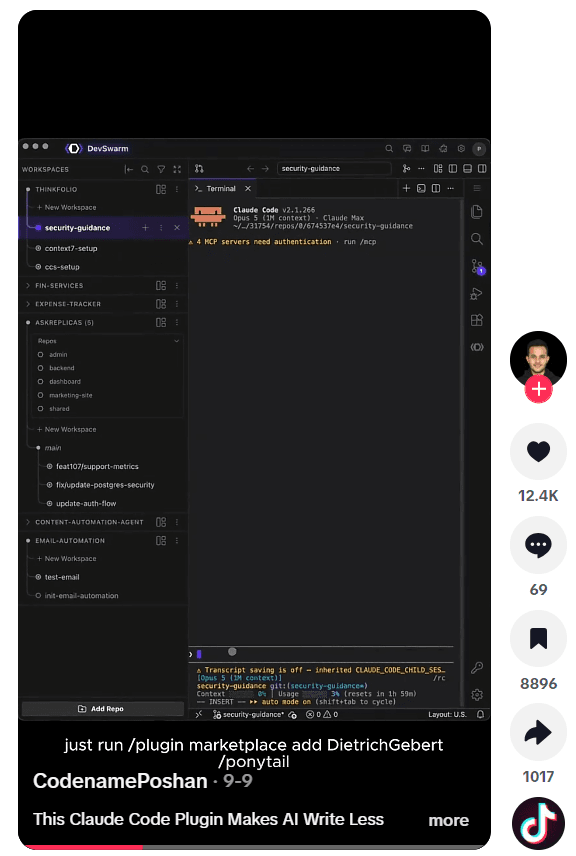 Native vertical terminal demo: Developer creator CodenamePoshan testing Claude Code plugins live in the command line, generating 12.4k likes and 8.8k saves from practicing engineers.
When developer creator CodenamePoshan published an unscripted screen walkthrough testing Claude Code terminal plugins, the video generated 12.4k likes and over 8,800 bookmark saves from practicing developers. The video did not feel like an enterprise sales pitch because the creator's webcam sat in the bottom corner while the terminal took center stage.
The YouTube teardown — architectural proof for senior buyers
While TikTok drives high-volume top-of-funnel sandbox trials, YouTube screen recordings close complex enterprise architectural questions. Principal architects and engineering managers turn to YouTube to watch peer practitioners stress-test tools against realistic benchmarks.
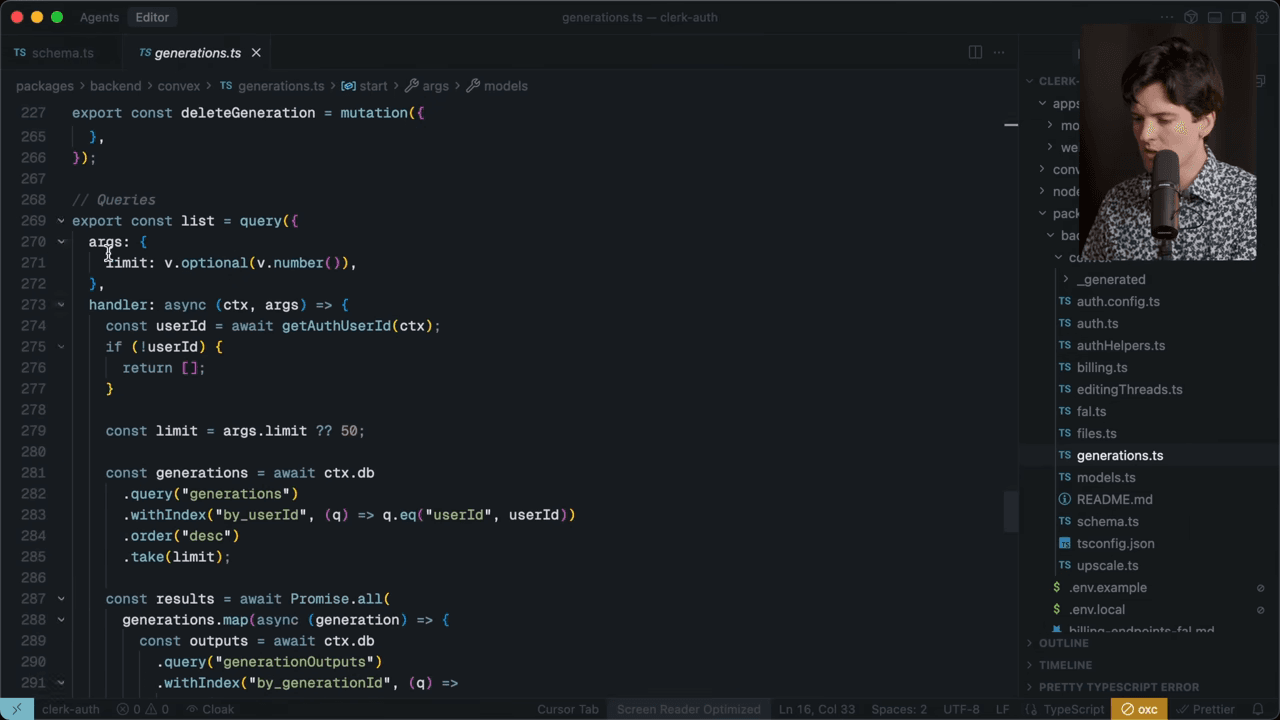 Peer technical evaluation: Theo Browne (t3.gg) inspecting Convex database backend schema, query structures, and indexing rules live inside VS Code.
When Theo Browne (t3.gg) reviews a database platform like Convex, he does not read bullet points from a marketing one-pager. He opens his editor, navigates directly to packages/backend/convex/generations.ts, writes actual queries, and evaluates how the TypeScript type safety behaves across schema migrations.
Technical buyers trust this format because the creator exposes edge cases and performance trade-offs that vendor sales teams routinely conceal during formal sales pitches.
Why legacy influencer databases fail to discover screen share practitioners
Most developer relations and B2B growth teams fail to scale practitioner demo programs because they attempt to source engineering talent through generic influencer databases built for consumer brands.
Platforms like Modash, Upfluence, and Grin rely on keyword matching across social media biographies. When you query terms like "software engineer", "full stack developer", or "DevOps", standard scrapers index profiles containing those literal strings. This creates a severe discovery bias:
-
Career transition vloggers: Individuals documenting their journey through coding bootcamps who have never deployed code to an enterprise production cluster.
-
Desk setup influencers: Creators reviewing mechanical keyboards, RGB lighting, and standing desks with high aesthetic appeal but zero software evaluation authority.
-
Meme aggregator accounts: Faceless channels reposting viral programming jokes without original screen demonstrations or technical commentary.
Working software engineers and DevOps architects rarely write "tech creator" or "influencer" in their TikTok or YouTube biographies. Instead, their technical authority exists exclusively in their spoken audio, visual terminal output, and real-time screen shares.
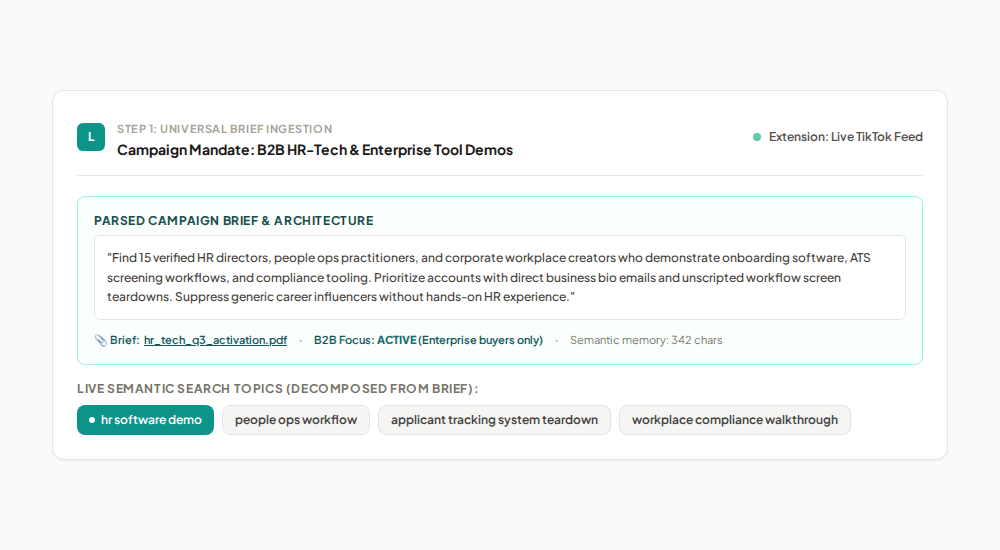 Semantic developer matching: Lobby decomposes technical product documentation into granular engineering topics, identifying creators actively demonstrating matching code in their videos.
Activating technical screen share creators with zero-friction outreach
Securing partnerships with practicing engineers requires an entirely different engagement model than working with lifestyle creators. Senior engineers earn competitive base salaries; they cannot be bribed with branded t-shirts, nor will they agree to read pre-written marketing scripts.
1. Zero corporate broadcast scripts
Never provide a technical creator with a teleprompter script or slide deck. The moment a software engineer reads corporate marketing copy, their audience recognizes the sponsorship as manufactured and tunes out. Provide three core assets:
-
Dedicated sandbox access with pre-loaded mock production data.
-
A single bullet point defining the primary engineering bottleneck your tool solves.
-
100% editorial freedom to critique edge cases and UX shortcomings.
2. High-converting 28-word unscripted pitch
Keep your initial outreach message under 35 words. Reference an exact technical topic they covered in a recent screen share to prove you watched their content:
"Saw your Tuesday teardown on PostgreSQL connection pooling under high concurrency. We built an open-source connection proxy that eliminates connection dropouts. Paid sprint: 3-minute unscripted terminal screen share testing it against your benchmark suite. Open to reviewing the repo?"
Because this pitch respects the engineer's technical competence and offers paid compensation for an unscripted evaluation, reply rates consistently exceed 25%, compared to the 2% industry benchmark for corporate outreach.
 Direct 1-to-1 outreach: Lobby automatically extracts verified practitioner contact details from bio link hubs and generates hyper-personalized, script-free pitch drafts.
Repurposing practitioner screen recordings into paid conversion funnels
The true economic leverage of practitioner screen demos is realized when organic assets are transformed into paid distribution funnels via Spark Ads on TikTok and Thought Leader Ads on LinkedIn.
Instead of running paid traffic from your corporate company handle (which suffers from immediate banner blindness), you license the practitioner's screen recording and amplify the post directly from their personal profile.
- Secure 90-Day Paid Whitelisting Rights: Include paid digital advertising usage rights in your initial creator agreement. Secure high-resolution source screen recordings (1080p 60fps) and uncompressed audio tracks.
- Pair Screen Demos with Frictionless Landing Sandboxes: Direct paid traffic to a lightweight landing page that embeds the creator's video directly above a browser-based playground. Eliminate mandatory demo request forms and company size qualification fields.
- Compound Organic Search Authority: Unlike paid banner ads that disappear the moment budget pauses, YouTube screen share reviews compound organic keyword authority across Google and YouTube Search for 18 to 24 months post-publication.
By systematically deploying fleets of 15 to 25 technical screen share creators, B2B SaaS companies replace bloated sales demo funnels with scalable, peer-validated customer acquisition engines.
Related B2B Creator Growth Playbooks
-
Review the comprehensive B2B creator marketing playbook for SaaS founders to map customer acquisition costs across technical cohorts.
-
Discover how bootstrapped teams acquire developer customers through video in the build in public customer acquisition playbook.
-
Learn why standard influencer databases fail technical filters in our breakdown of developer marketing and sourcing technical micro-creators.
-
Study the step-by-step breakdown of engineering high-converting B2B product demos with industry practitioners.
Tired of static influencer databases?
Lobby replaces dead directories with live TikTok creator search and direct outreach. Zero manual vetting, verified contacts, and live engagement metrics.